Solar Panel Installer Runcorn, an independent guide › Flat roofs
Flat or pitched: which roof makes more?
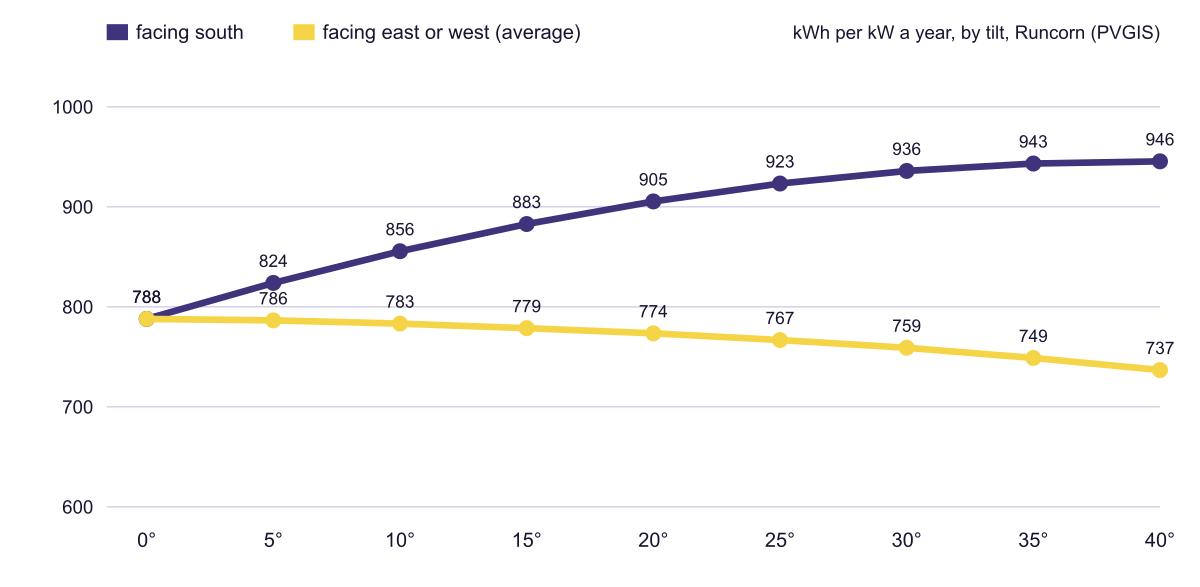
A pitched roof decides the panels' direction and angle for you. A flat roof lets you choose both, but makes you pay for the choice in spacing and frames. Here is how they compare in Runcorn, per panel and per roof.
Checked against its sources on 3 November 2026. Published by SEO Dons; we do not supply or install solar.
Per kW of panels
| Roof and layout | kWh a year per kW | Compared with south at 35° |
|---|---|---|
| Pitched roof facing south, 35° | 943 | 100% |
| Pitched roof facing east or west, 35° | 749 | 79% |
| Flat roof, panels facing south at 15° | 883 | 94% |
| Flat roof, panels facing south at 10° | 856 | 91% |
| Flat roof, east-west pairs at 10° | 783 | 83% |
| Flat roof, panels lying flat (0°) | 788 | 84% |
PVGIS 5.3 for Runcorn, 14% losses, read 3 November 2026.
Per roof
On a pitched roof the number of panels is set by the slope's size and shape. On a flat roof it is set by the tilt you choose, because steeper rows need wider gaps between them to avoid shading each other. That is why low tilts usually win on a flat roof: each panel makes a little less, but many more fit. The flat-roof planner shows the trade-off for your own roof.
Practical differences
- Fixing. Pitched roofs take brackets screwed to the rafters. Flat roofs take frames held by ballast or fixed through the covering, which must then be sealed and guaranteed.
- Height limit. A flat-roof array on a house must stay within 0.6 m of the roof to be permitted development. Pitched-roof panels must stand no more than 0.2 m off the slope.
- Upkeep. Low-tilt panels need cleaning a little more often; flat roofs are usually easier to reach.
- The covering. Flat-roof coverings tend to need renewing more often than tiles or slates; time the panels to suit.
Summer and winter
Tilt changes when a panel makes its electricity as well as how much. In PVGIS's monthly figures for Runcorn, a south-facing panel at 10 degrees slightly out-produces one at 35 degrees in June, about 120.6 kWh per kW against 116.2, because the summer sun is high. In December it makes little more than half as much, 16.3 against 28.2, because the winter sun is low and strikes the shallow panel at a glancing angle. A flat-roof array therefore leans towards summer. That suits a household that uses more power in summer, and it is a point against buying a large battery for winter.
Which to choose when there is a choice
- The main roof faces between south-east and south-west. Start there: it gives the most per panel, needs no frames and takes the usual brackets.
- The main roof faces east or west. Panels on both slopes still work well; a south-facing flat roof can add the midday output the slopes miss.
- The main roof faces north. A flat roof is the way in, at a low tilt facing south or as east-west pairs.
- Either roof is tired. Whichever covering is closer to the end of its life should be renewed before anything is fixed to it.
Using both
Many houses have both: a pitched main roof and a flat-roofed extension, garage or dormer. A main roof facing east or west plus a south-tilted array on the flat roof can make a well-balanced system, with the inverter set up to handle the two parts separately.
Keep reading
Where the figures come from
Questions about roof types
Is a flat roof or a pitched roof better for solar?
Per panel, a south-facing pitched roof does best: about 943 kWh a year per kW in Runcorn at 35 degrees (PVGIS). Per roof, a flat roof can match or beat it, because you choose the direction and can pack low panels densely.
Why not lay panels flat on a flat roof?
They make less (about 788 kWh per kW a year here), and dirt and water sit on them. A small tilt, even 5 to 10 degrees, helps rain wash them clean.
My pitched roof faces north. Is solar out?
On that roof, mostly. But a flat-roofed garage, extension or dormer can carry panels facing whichever way works best.
A flat roof, a quote, or a question about your Runcorn home?
Tell us about the roof or the quote, with your Runcorn postcode. Your message goes to SEO-DONS LTD, the company behind this independent guide, and the reply comes by email. Asking is free and commits you to nothing.
What happens next
- Fill in the form; your postcode tells us which part of Runcorn you are in.
- We look at what you sent and reply by email with the figures and sources that fit.
- Whether you go ahead, and with which firm, is up to you.